
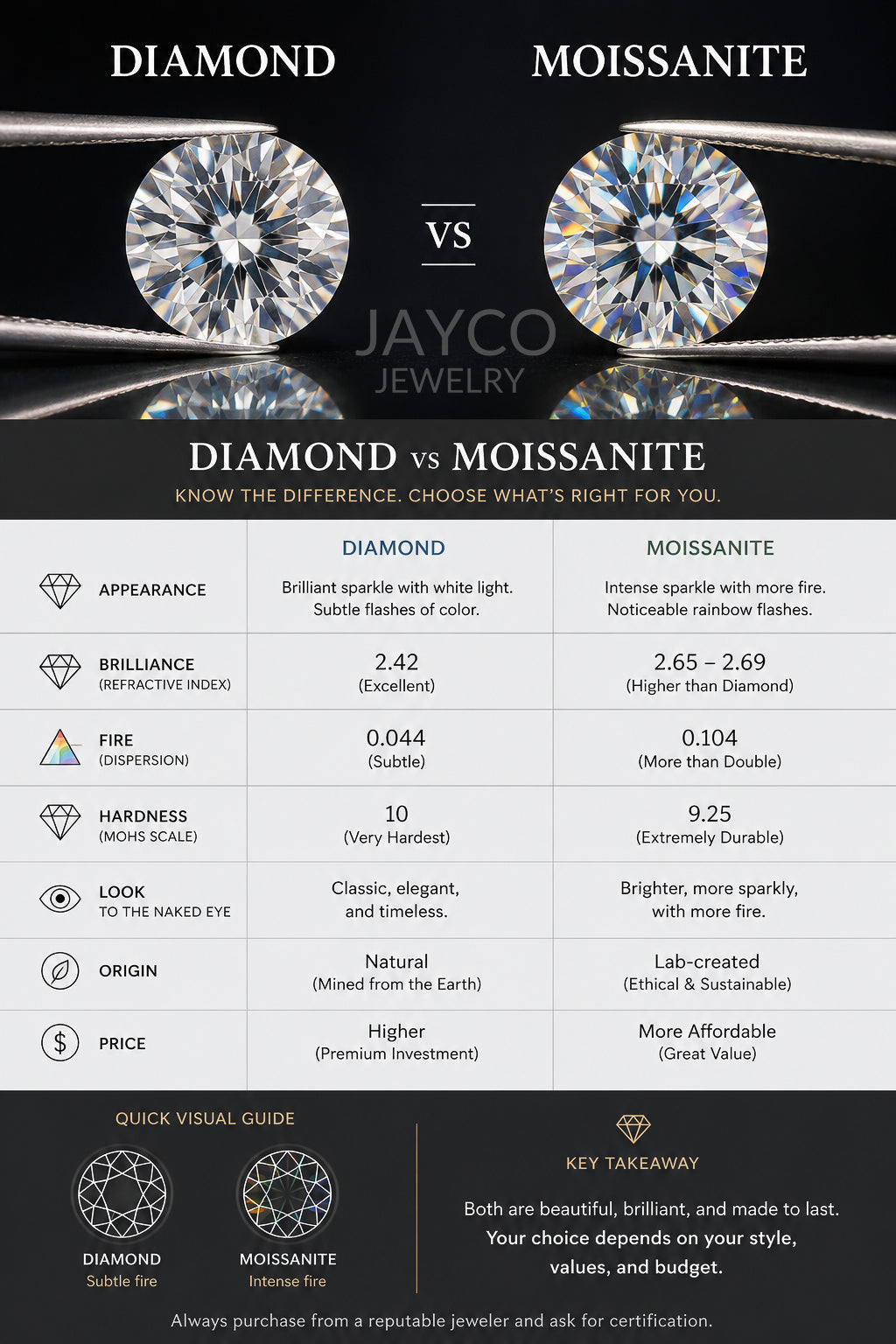
If you've been searching moissanite vs diamond, you're not alone. Moissanite has become one of the fastest-growing alternatives to mined diamonds and for good reason. But with so much conflicting information online, it can be hard to know what's actually true. This guide cuts through the noise with honest, side-by-side comparisons so you can make the best decision for your budget, values, and style.
What Is Moissanite?
Moissanite is a gemstone made of silicon carbide (SiC). It was first discovered in 1893 by French chemist Henri Moissan inside a meteor crater in Arizona — which is why it's sometimes called a "space gem." Natural moissanite is extraordinarily rare, so virtually all moissanite sold today is lab-created, grown in controlled environments that replicate the conditions under which the original crystals formed.
Lab-created moissanite is not a fake diamond. It is a distinct gemstone with its own chemical composition, optical properties, and crystal structure. Think of it the way you'd think of sapphire vs. ruby as both are real gemstones, just different ones.
How Is Moissanite Made?
Modern moissanite is produced through a process called the Lely method, where silicon carbide is grown in a high-temperature furnace over several weeks. The resulting crystals are then cut and faceted by skilled gem cutters. The process is tightly controlled, which means lab-created moissanite is nearly always eye-clean (no visible inclusions) and consistent in color and typically in the near-colorless (G–H) to colorless (D–F) range.
Because it's grown in a lab, there's no mining involved, no environmental disruption, and no supply-chain opacity. You know exactly what you're getting.
Brilliance, Fire & Sparkle: How Do They Compare?
This is where moissanite genuinely surprises people, especially those who assume "lab-created" means "less sparkly."
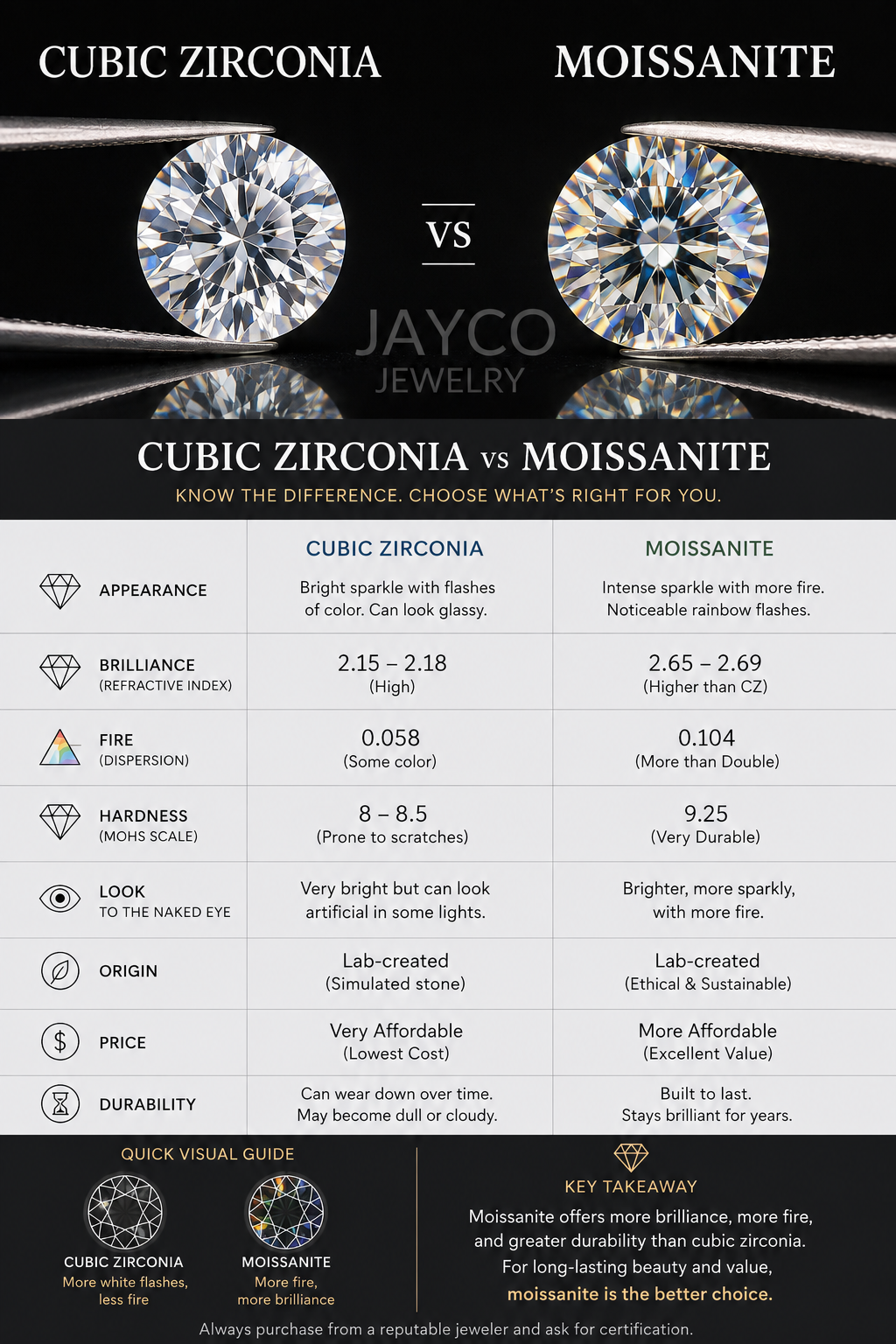
- Refractive Index: Moissanite scores 2.65–2.69 vs. diamond's 2.42. A higher refractive index means more light is bent as it passes through the stone — producing more brilliance (white sparkle).
- Fire (Dispersion): Moissanite's dispersion rating is 0.104 vs. diamond's 0.044. That means moissanite throws off significantly more rainbow-colored flashes of light, especially in sunlight or bright indoor lighting.
- Hardness: Diamond is the hardest natural substance on earth at 10 on the Mohs scale. Moissanite comes in at 9.25 — harder than sapphire, ruby, or any other gemstone you'd commonly wear. For everyday jewelry, moissanite is extremely durable and scratch-resistant.
Bottom line: Moissanite is actually more brilliant than diamond by measurable optical standards. Some people prefer diamond's subtler sparkle; others love moissanite's high-energy flash. Neither is wrong — it's a matter of taste.
Will Moissanite Pass a Diamond Tester?
This is one of the most-searched questions about moissanite — and the answer is nuanced. Traditional thermal diamond testers will read moissanite as diamond, because moissanite conducts heat similarly to diamond. However, newer multi-tester devices that also test electrical conductivity can distinguish between the two. So: moissanite will fool a basic tester, but not an advanced one. This is worth knowing if you're ever asked to verify a stone.
Price Comparison: Real Numbers from Our Catalog
The price difference between moissanite and diamond is dramatic — and it's not because moissanite is "cheap." It's because diamonds carry a significant markup driven by marketing, controlled supply, and perceived scarcity.
Here's what comparable pieces look like at Jayco Jewelry vs. the diamond equivalent:
- Moissanite Round Cut Stud Earrings — from $24 (3MM) to $39 (5MM). A comparable pair of 0.5ct diamond studs in sterling silver typically runs $200–$500+.
- 3MM Moissanite Tennis Bracelet in Solid 925 Silver — from $115 (6") to $145 (7.5"). A diamond tennis bracelet of similar length and stone size starts at $1,500–$3,000.
- 2MM Moissanite Eternity Ring in 925 Sterling Silver — $60 across all sizes. A comparable diamond eternity band starts at $800–$2,000.
The savings range from 80–95% compared to diamond equivalents — without sacrificing durability, brilliance, or beauty.
Ethics & Sustainability
If you care about where your jewelry comes from, moissanite has a clear advantage. Diamond mining — even with certifications like the Kimberley Process — has a complicated history involving environmental damage, labor concerns, and supply-chain opacity. Lab-created moissanite sidesteps all of that:
- No mining, no land disruption
- No conflict-mineral risk
- Fully traceable origin (grown in a lab, not extracted from the earth)
- Lower carbon footprint per carat than mined diamonds
For buyers who want a beautiful stone they can feel good about, moissanite is an easy choice.
How to Choose Between Moissanite and Diamond
Here's a simple framework:
- Choose moissanite if: You want maximum sparkle per dollar, you care about ethical sourcing, you're buying everyday jewelry (earrings, bracelets, stacking rings), or you want to buy multiple pieces instead of one expensive stone.
- Choose diamond if: You specifically want a mined stone for sentimental or traditional reasons, you're buying a piece you plan to resell or pass down as an investment, or you prefer diamond's subtler, cooler sparkle.
For most buyers — especially those shopping for earrings, tennis bracelets, or eternity rings — moissanite delivers equal or better visual impact at a fraction of the cost.
From everyday studs to statement tennis bracelets, our moissanite pieces are crafted in solid 925 sterling silver and solid gold vermeil. Browse best sellers →
About Jayco Jewelry
At Jayco Jewelry, we believe fine jewelry shouldn't require a fine-jewelry budget. We specialize in lab-created moissanite pieces — earrings, bracelets, rings, and more — crafted in solid 925 sterling silver and gold vermeil. Every piece is designed to be worn daily, gifted with confidence, and loved for years.
Questions about a specific piece or stone size? Contact us — we're happy to help you find the perfect match.

Leave a comment
This site is protected by hCaptcha and the hCaptcha Privacy Policy and Terms of Service apply.